Increased Wealth Without Increased Income

Agenda:

1.    How to spend money to maximize happiness

2.    Defensive Investor Strategy Performance (down 1.3% in last 12 months)

3.    “All Seasons” Strategy Performance (down 3.9% in last 12 months

I usually write about strategies one can use to maximize their long-term wealth, however, what good is wealth if it doesn't bring you happiness?

Thinking about your long-term plan of how to make more money is a total waste of time, if you aren't going to spend that money in a way that will maximize happiness for you and your family.

Let's explore this together... 

Sometimes it's easy to fall into the trap of thinking that life would be easier (or you would be happier) if you made more money:  if you could just get a 10% raise? Or if you didn't have to pay a mortgage? In my experience, this approach is problematic. A year later, even if things work out as planned (and you got that 10% raise or magically pay off your house), you are unlikely to be happier. Why?

If you read the mass media, you have likely seen that: 

Thus, we appear to be stuck in the "money doesn't buy happiness" problem. I'd argue that "money doesn't buy happiness" is incorrect, that "money typically doesn't buy happiness" is more appropriate. With some effort, you can use solid scientific evidence to spend money in ways that can concretely increase happiness - effectively increasing your "wealth" without increasing your income.

I'd like to encourage you to focus on spending money differently rather than making more money. To be fair, I don't claim to be great at this, but I hope to get better. I discovered the following recommendations from the book "Happy Money: The Science of Happier Spending"- it's a good book and you should read it, but even if you don't, I encourage you to spend more mental energy thinking about if you are spending your money wisely - in a way that maximizes happiness - than on finding ways to make more money.

Per the authors:

Every large bookstore has a shelf filled with books designed to help you get more money. By focusing on how to spend the money you have rather than how to accumulate more of it, our perspective departs from the obsession with chasing increased wealth in the pursuit of happiness. New research shows that greater wealth often fails to provide as much happiness as many people expect. In a national sample of Americans, individuals thought that their satisfaction with life would double if they made $55,000 rather than $25,000: twice as much money, twice as much happy. But the data revealed that people who earned $55,000 were only 9 percent more satisfied than those making $25,000.

According to the book, there are five basic principles that can help increase your happiness.

1. Buy Experiences - this is simple, you are more likely to experience happiness from experiences (a road trip, a concert, sky driving, bike ride with friends, etc.) than from material possessions... again, per the authors:

Shifting from buying stuff to buying experiences, and from spending on yourself to spending on others, can have a dramatic impact on happiness.

2. Make it a Treat - when the special becomes the routine, it fails to produce the same level of enjoyment. This is the classic overconsumption problem: it happens to me with caffeine, cinnamon rolls, and burritos. Simply, when things are a special treat you enjoy them more (this reminds me of a theory economists call the law of diminishing marginal utility), but don’t over-indulge in them or they will become less special.

3. Buy Time - when possible, you should "buy" time. The book argues that paying for something like housecleaning is one of the best ways to use money to increase your happiness. If it takes you four hours to clean your house, paying someone else to clean it helps you get four hours back (having four more hours in your day can make you happier). I like to think this also applies to jobs; which job is likely to make you happier: Job A where you work 40 hrs/week and get paid X, Job B where you 60 hrs/week and get paid X + 15% or Job where you work 80 hrs/week and get paid X + 50%. If you can pay the bills with Job A, it may be the ideal choice to maximize your happiness. 

4. Pay Now, Consume Later - if you can disassociate the "pain" of paying for the experience/treat from the act of enjoying it, you can enjoy it more. If you pay for something like a vacation far enough in advance it can almost feel "free" when you enjoy it. Unfortunately, most of society does the opposite; they enjoy something now and pay for it later using a credit card.

5. Invest in Others - volunteer, give time and money to people less fortunate than you. These activities and actions are proven to make you happier. 

When possible, you should even try to combine these principles. The book closes with a slightly extreme example (but it really illustrates many of the key points):

As we saw in the last chapter, a Starbucks gift card provided the most happiness when people used it to buy coffee for someone else, while accompanying them to Starbucks—which allowed them not only to invest in others (chapter 5), but also to buy an experience (chapter 1), and change the way they spent their time that day (chapter 3). And in your daily life, you could knock off the other two principles by paying up front for the Starbucks card at the beginning of the week (chapter 4) and putting just enough money on the card to buy a basic coffee Monday through Thursday, but a Frappuccino on Friday—making that delicious dose of creamy caffeine a treat (chapter 2).

I hope enjoyed the slight detour from my typical subject matter – enjoy the raise.

My Benjamin Graham inspired fund has underperformed the S&P 500 recently. 

In the last 12 months, it is down 1.3% (through July 7, 2017). 

Defensive Investor Notes: My personal favorite investment strategy uses Benjamin Graham’s (Warren Buffett’s mentor and professor at Columbia Business School) guidance to identify companies with a strong cash position, low debt, and stable dividends paid over many years that are trading at bargain prices. Similar techniques have yielded annual returns of approximately 18% since 2001.

Returns since creation shown below:

          Date                                Defensive Investor Performance           S&P 500 Performance

07/22/15 - 12/31/15        +1.0%                                                    -1.9%

12/31/15 - 12/30/16        +22.0%                                                  +12.0%

12/30/16 - 07/07/17       -5.6%                                                      +8.6%

My more conservative "All Seasons" inspired fund is down 3.9% in the last 12 months (through July, 7 2017).

Notes on the All Seasons Strategy: I use this strategy for cash management (and to minimize draw-downs). It is intended to reduce volatility without significantly reducing upside. From 1973 - 2012 the max draw-down of this approach was only 14.4% (http://mebfaber.com/2013/07/31/asset-allocation-strategies-2/), yet the compound annual return was a very solid 9.5%. One additional note- this strategy is 70% bonds, which have been in a bull market for 30+ years (this overlaps with the back-testing period). In my opinion, it is unlikely to perform as well in the next 30 years as it has in the last 30 years.

Returns since creation shown below:

Date                                All Seasons Performance

09/11/15 - 12/31/15       -1.3%

01/01/16 - 12/31/16       +2.7%

01/01/17 - 06/01/17       +2.7%


Inversion Thinking

Agenda:

1.    Inversion Thinking

2.    Defensive Investor Strategy Performance (up 41.8% in last 12 months)

3.    All Seasons Strategy Performance (up 2.5% in last 12 months)

Many good value investors have written about Charlie Munger's use of an approach called inversion thinking. I'd like to briefly discuss inversion thinking in this quarter's newsletter, as well as why I believe that inversion thinking makes a strong case for quantitative investing. Tren Griffin, a Munger biographer, describes this problem-solving approach much more eloquently than I can:

Charlie Munger has adopted an approach to solving problems that is the reverse of the approach that many people use in life. Inversion and thinking backwards are two descriptions of this method. As an illustrative example, one great way to be happy is to avoid things that make you miserable. 

Munger even jokes that he wants to know where he will die so he can just not go there. -25iq

I'll attempt to leverage Munger's philosophy to explain how to make wise investments. If you want to make money investing (grow long-term wealth), and you use inversion thinking, start by asking how you would destroy long-term wealth. The next time you decide you would like to destroy your wealth, I would recommend the following:

·       Pay high fees and/or commissions

·       Buy expensive or speculative assets

·       Trade frequently

·       Use leverage

·       Make emotional decisions about buying or selling assets

If you have read my previous newsletters these suggestions won't come as a surprise (I often recommend the opposite). At this time, I’d like to focus on making emotional decisions. Before we can improve our decision making, we first must understand that we are prone to making poor investing discussions. One typical decision-making deficiency is illustrated in the Greenblatt study. The study identified a group of stocks that outperform the market over time and gave investors two options:

1.    To choose when they buy and sell stocks on the list (self-managed)

2.    To have a formula determine when to buy and sell stocks on the list (this quantitative approach was described in the study as "professionally managed")

The self-managed account allows clients to choose which stocks to buy and sell from a list of approved Magic Formula stocks. Investors were given guidelines for when to trade the stocks, but were ultimately able to decide when to make those trades. Investors selecting the professionally managed accounts had their trades automated. The firm bought and sold Magic Formula stocks at fixed, preset intervals. During the two year period in Greenblatt's study, both types of account were able to select only from the approved list of Magic Formula stocks.

If investors in the study made rational decisions about the appropriate times to buy and sell stock, I would expect them to outperform the market significantly (because they were given a basket of stocks that outperformed the market).

…What happened? The self-managed accounts, where clients could choose their own stocks from the preapproved list and then exercise discretion about the timing of the trades, slightly underperformed the market. An aggregation of all self-managed accounts for the two-year period showed a cumulative return of 59.4 percent after all expenses, against the 62.7 outperformance of the S&P 500 over the same period. The aggregated professionally managed accounts returned 84.1 percent after all expenses over the same two years, beating the self-managed accounts by almost 25 percent (and the S&P by well over 20 percent) (emphasis mine). For a two-year periods a huge difference. It's especially so since both the self-managed accounts and the professionally managed accounts chose investments from list of stocks and followed the same basic plan. People who self-managed their accounts took a winning system and used their judgment to eliminate all the outperformance and then some (emphasis mine). Greenblatt has a few suggestions about what caused the underperformance, and they are related behavioral biases. - From "Quantitative Value" by Wesley Gary and Tobias Carlisle

The investor's "best judgment" was the difference between outperforming and underperforming the S&P 500. Most investors show similar underperformance in "self-managed" accounts because of emotional decision making when buying and selling stock (causing them to buy high / sell low). We can leverage inversion thinking to solve this problem: if self-management and emotional decision-making are the problem, using a systematic approach is an ideal solution. Depending on your investing approach, implementation of a systematic or quantitative approach might vary:

1.    For an index investor – it probably means buying at predefined intervals (every two-weeks, monthly, etc.)

2.    For a disciplined value investor – it likely means buying when a stock is significantly below fair value and selling when the stock reaches fair value

3.    For a less disciplined value investor – it likely means buying stocks that are significantly below fair value and selling after a defined period of time (one year, three years, etc.)

Is your "best judgment" the cause behind your investment’s underperformance? It's worth some thought. If so, consider adding a quantitative element to your investing approach. 

If you are interested in additional reading on the subject check out the following links: on Munger; on Quantitative Investing.

My Benjamin Graham inspired fund has outperformed the S&P 500.

In the last 12 months, it is up 43.2% (through December 21, 2016). 

Defensive Investor Notes: My personal favorite investment strategy uses Benjamin Graham’s (Warren Buffett’s mentor and professor at Columbia Business School) guidance to identify companies with a strong cash position, low debt, and stable dividends paid over many years that are trading at bargain prices. Similar techniques have yielded annual returns of approximately 18% since 2001.

My more conservative "All Seasons" inspired fund is up 2.5% in the last 12 months (through December, 21 2016).

Notes on the All Seasons Strategy: I use this strategy for cash management (and to minimize draw-downs). It is intended to reduce volatility without significantly reducing upside. From 1973 - 2012 the max draw-down of this approach was only 14.4% (http://mebfaber.com/2013/07/31/asset-allocation-strategies-2/), yet the compound annual return was a very solid 9.5%. One additional note- this strategy is 70% bonds, which have been in a bull market for 30+ years (this overlaps with the back-testing period). In my opinion, it is unlikely to perform as well in the next 30 years as it has in the last 30 years.

Familiar Stocks, probably a poor investment

The first stock I purchased in my early 20's was a clothing brand that I liked. They had just purchased a manufacturer of skis and snowboards. I purchased the stock because:

  1. It was familiar to me
  2. The company made products I liked (clothes, skis & snowboards)
  3. The stock price was only $7 per share
  4. I had no idea what the company was worth (Ed. note: at this time it was probably was $3-$4 per share)

So, I purchased a stock at $7 per share that was probably worth $3.50 a share... clearly this purchase was a mistake, and I believe it is a fairly common one. Why would someone make an investment without understanding: the business model, the true value of the company or the competitive landscape? In most cases, the answer is: simply because it is familiar.

It seems to me that we often make similar decisions in life. We might buy a car, a computer or a phone that our friends own because it is familiar to us. We might use an insurance agent, mortgage broker or real estate agent that is a friend. This thought process is fairly logical. You want an insurance agent that you can trust, and it seems easier to trust someone with whom you have a preexisting relationship. The question then becomes: is using your insurance agent friend the best business decision? In some cases it may be, but in many cases, there is probably someone with whom you have no preexisting relationship who can provide better service, rates and coverage. What I'm trying to prove is that buying a familiar stock is sort of like buying insurance from a friend with non-competitive rates... except worse, because there is no social benefit to owning a stock with which you are familiar (and there are often social benefits to doing business with a friend).  

Assuming you are investing to increase your long-term wealth, why would you only buy stocks from a handful of companies with which you're familiar, when you could buy thousands of other investments? I imagine it is because the unknown can be scary. In my case, the thought of buying the stock of a company I knew nothing about, in an industry I knew nothing about, was frightening. If I knew next to nothing about the process of buying and selling stocks, I might as well have a little familiarity with the stock I'm purchasing, right?

Let's look into my past purchase to see what we can learn from this mistake. Below is the price chart, with a step-by-step review of my actions and a post-mortem grade for each step.

ZQK stock price from 2008 - early 2011

ZQK stock price from 2008 - early 2011

  1. I purchased the stock in late 2008 at about $7 per share. Post-mortem grade: F (the stock's true value was somewhere around $3.50 per share)
  2. In the next three months the stock price went from $7 to about $1 (in three months, the price of my first stock purchase was down 85%). What did I do? I finally started researching the company, I worked to understand the competitive environment and fundamentals. Post-mortem grade: B (I should have done this research initially, but I now had some idea of the true value of my investment)
  3. Six months later, I decide to purchase more shares at about $1.50 per share. I now had a better understanding of the company and thought the company was worth at least twice the current price. The drop in price allowed me to purchase almost five times as many shares for the same amount as my initial investment. Post-mortem grade: B+ (if I was willing to pay a sufficiently higher price for the stock nine months ago, and the fundamentals of the company haven't changed, I should be happy to invest more money at a discounted price)
  4. In 2010, I sold all my shares at about $5 per share. Post-mortem grade: B- (I ended up making a nice profit, but much of that was luck. I should have never made the initial purchase.) 

Now that we have reviewed my least intelligent stock purchase, let's quickly look at a few more successful purchase decisions. In 2012, I bought Corn Product International (now Ingredion), "a leading global ingredients solutions company," with which I was previously unfamiliar. It had an attractive valuation and strong fundamentals. The more I researched the company, the more I was impressed with their business model. The stock price has more than doubled in four years. Corning, "one of the world’s leading innovators in materials science," is a similar story. I purchased the stock because of attractive business fundamentals (not my familiarity with the company) and I've made a nice return.

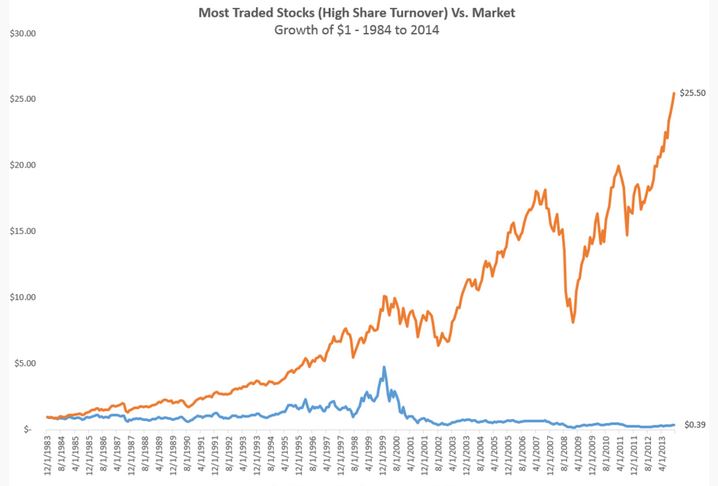
So do the three examples above prove a trend? Absolutely not. Let's review this suggestion that you should be stocks based on fundamentals and not familiarity at a larger scale. Patrick O’Shaughnessy backtested a similar investment strategy recently. In this case, he tested how "popular" stocks (in my eyes a popular stock is a nice proxy for a well known stock) compared to the market. Popular stock are often expensive (high P/E, P/B, etc.) because they are well known. An expensive company has high expectations of future growth. The high expectations are often tough to fulfill, and when the high expectations aren't met the stock price often drops (sometimes significantly). This is shown below, the popular companies (blue line) with high expectations, often failed to meet those expectations and were therefore significantly out performed by the market of all stocks (orange line).

How can you change the process to "stack the deck in your favor"? Instead of buying stocks based on what is familiar to you, buy stocks based on their true value (I will discuss the best stock valuation methods in a future issue). However, as discussed previously, if you're a novice investor owning individual stocks probably isn't a great idea.

Takeaway - Simply purchasing stocks based the fact that they are well known to you has a low probability of success. In today's environment, this might mean that purchasing stock in Dillard's (a "boring" retail store, that you may not shop at, but that has strong fundamentals) has a higher probability of success than Google (the world's most valuable company, which dominates the world's search and mobile phone markets). After all, the most valuable companies in the world (which are familiar to all of us) have significantly under-performed the S&P 500 since 1972.

Valuation metrics and under-priced stocks

US EQUITY VALUATION

Shiller P/E (CAPE Ratio) | As of 012/12/2015

http://www.multpl.com/shiller-pe/

Mean: 16.63, Median: 16.01, Min: 4.78 (Dec 1920), Max: 44.19 (Dec 1999), Implied future annual return (over 8 years) = 2.9% to -3.2%

Notes on valuation: I look at valuation metrics (like the CAPE ratio shown on the above) to provide some context of how expensive stocks are compared to historical levels. Currently, valuations are above average.

THE DEFENSIVE INVESTOR strategy

Inspired by Benjamin Graham


Defensive Investor Notes: My personal favorite investment strategy uses Benjamin Graham’s (Warren Buffett’s mentor and professor at Columbia Business School) guidance to identify companies, with a strong cash position, low debt, and stable dividends paid over many years that are trading at bargain prices. Similar techniques have yielded annual returns of approximately 18% since 2001.

WORLD’S CHEAPEST STOCK MARKETS

Notes on the world's cheapest stock markets: Investing strategies that buy the world’s most affordable stock markets have proven to be very successful in the past (averaging an annual return of approximately 16% from 1980-2013). For that reason, I keep a close eye on investing opportunities overseas.

The ETF GVAL (http://www.morningstar.com/etfs/arcx/gval/quote.html) leverages this investing strategy for a reasonable fee. Star Capital (http://www.starcapital.de/research/stockmarketvaluation) tracks the world's most undervalued stock markets on a quarterly basis.

the all seasons (risk parity) strategy


Notes on the All Seasons Strategy: I use this strategy for cash management (and to minimize draw-downs). It is intended to reduce volatility without significantly reducing upside. From 1973 - 2012 the max draw-down of this approach was only 14.4% (http://mebfaber.com/2013/07/31/asset-allocation-strategies-2/), yet the compound annual return was a very solid 9.5%... One additional note, this strategy is 70% bonds, which have been in a bull market for 30+ years (which overlaps the backtesting period). In my opinion, it is unlikely to perform as well in the next 30 years as it has in the last 30 years.

Performance Tracking Added

I've recently added performance tracking to the website for two of my favorite investing strategies.


From July 22, 2015 to June 9, 2016 the Benjamin Graham Defensive Investor Strategy was up 21.9%. I rebalanced the strategy on June 9, 2016; there are now six stocks that meet the criteria.


The All Season Fund is designed to minimize draw-downs. It has also performed well recently.

Finance Research Recap by Wesley Gray

Wesley Gray did a great "Academic Research Recap" on articles that have changed his mind/approach over the years. It's the best thing I've read in months. Go read it. Below is one quote from the article. 

 "Essentially, long duration investment opportunities, while attractive in a perfectly rational world with full information, are not necessarily attractive if they make a manager look bad in the short-run, and the investors pull all their money when the manager performs poorly relative to a benchmark in the short-run."

image.jpg

Noah Smith says "You're Making Your Financial Adviser Rich"

Noah Smith has a nice article in Bloomberg, on adviser fees. Quotes and the link are below:

 "Now, with the industry-standard 1 percent management fee, you pay a full 25 percent of your life’s savings to your money manager. It’s much higher than before, and because since you’re earning a higher return, the fee gets sliced off of a bigger and bigger salami.

Think about that for a moment. What else would you spend so much money on? Your house, and that’s it. After your house, asset management will be the most expensive thing you ever buy."

 "If your wealth manager helps you take more risk and make fewer bad choices, and if this boosts your average lifetime return by 2 percent a year, then he has more than earned his 1 percent fee."

 http://www.bloombergview.com/articles/2016-04-11/those-tiny-fees-make-your-financial-adviser-rich


The Best Performing Stocks Have Frequent & Significant Downturns

Morgan Housel has another excellent column on the common volatility of stocks, including the best performing stocks in the past 20 years. He includes the classic Munger quote:

"This is the third time that Warren [Buffett] and I have seen our holdings in Berkshire Hathaway go down, top tick to bottom tick, by 50%. I think it's in the nature of long-term shareholding that the normal vicissitudes in markets means that the long-term holder has the quoted value of his stocks go down by, say, 50%.

In fact, you can argue that if you're not willing to react with equanimity to a market price decline of 50% two or three times a century you're not fit to be a common shareholder, and you deserve the mediocre result you're going to get compared to the people who can be more philosophical about these market fluctuations."

image.jpg
image.jpg